
Los Angeles Airbnb Rules and Permit Requirements (Updated October 2026)
Los Angeles Airbnb rules require anyone renting their home for 30 nights or fewer to hold a Home-Sharing registration from the City. The home must be your primary residence, where you live more than six months of the year. There are two registration types, Regular and Extended, each with its own limit on how many days you can rent per year.
The City changed its rules on September 28, 2026, when revised Home-Sharing Administrative Guidelines took effect alongside a new application portal. This page describes the rules as they stand now. We walk every property owner through this process during onboarding and guide compliance across all listing platforms as part of our Airbnb management services.
Last updated: October 8, 2026
Do You Need a Permit for Airbnb in Los Angeles?
If you plan to rent your home for 30 consecutive days or less in the City of Los Angeles, yes. The City requires Home-Sharing registration before you list your property on any platform, including Airbnb, VRBO, Booking.com, and Google Vacation Rentals.
Rentals longer than 30 consecutive days are not classified as Home-Sharing and do not require this registration. Hotels, motels, Transient Occupancy Residential Structures and bed-and-breakfasts operate under separate regulations.
The registration applies to the home, not the platform. Whether you list on one site or five, you hold one Home-Sharing registration, and that registration number must appear on every listing. One person can hold only one registration in the City at a time (Guidelines III.1.c.iii).
Los Angeles Home-Sharing Ordinance: How It Works
The Home-Sharing Ordinance restricts short-term rentals to a host's primary residence. This is the single most important eligibility requirement. Investment properties, second homes, and properties where the host does not live more than six months of the year do not qualify. The September 2026 update did not change the primary-residence rule or the 120-day cap; it changed how you prove eligibility and how you renew.
Who Can Register
- You are a natural person (not an LLC or other entity) applying for your sole primary residence, where you live more than six months of the calendar year
- The unit is not subject to the Rent Stabilization Ordinance (RSO) or to an affordable-housing covenant or income restriction
- The unit is in a structure approved for residential use (not a garage, shed, trailer, vehicle or tent)
- The host, unit and property have no open or pending citations from any City enforcement agency (Guidelines III.1.c.iv)
- If you are a tenant: the property owner has signed the City's Property Owner Authorization to Conduct Home-Sharing, notarized
Who Cannot Register
- Units under the Rent Stabilization Ordinance (RSO)
- Units with affordability covenants or income restrictions, and buildings converted from RSO apartments to single-family homes within the last five years
- Investment properties or second homes (not primary residence)
- Properties with open or pending City citations
- Tenants whose landlord has not authorized Home-Sharing, or has filed a proactive prohibition with the City
- Hosts whose registration is currently suspended or revoked
ADUs and Guest Houses
An ADU whose building-permit application was filed on or after January 1, 2017 can be registered only if LADBS has issued a Certificate of Occupancy for it as an ADU, and only if the ADU itself is the applicant's primary residence (Guidelines III.1.c.ii(2)(a)). An ADU without a Certificate of Occupancy cannot be registered.
An ADU on the lot can also change the RSO picture for the main house. Check ZIMAS for the most current records on every unit on the parcel, or ask the Home-Sharing Unit. Garages, pool houses and other spaces not approved for residential occupancy do not qualify.
How to Check RSO Status
The Rent Stabilization Ordinance applies to many older multi-unit buildings in Los Angeles. If your unit is subject to RSO, it cannot be registered for Home-Sharing. To check:
- Go to ZIMAS (zimas.lacity.org)
- Enter your property address
- Check the "Housing" tab for RSO status
- If unclear, call LAHD RSO Determinations: (213) 928-9075. The City may require a Letter of Determination from LAHD.
Regular vs. Extended Home-Sharing Registration
The City offers two registration types. Regular allows up to 120 days of Home-Sharing per calendar year; Extended allows up to 365. Every host starts with Regular, and both registrations last 12 months.
| Regular Registration | Extended Registration | |
|---|---|---|
| Maximum days per calendar year | 120 days | Up to 365 days |
| Prerequisite | None (first-time applicants start here) | Active Regular registration, plus 6+ months registered or 60+ hosted days |
| Base filing fee | Starting at $441, plus City surcharges | Starting at $883, plus City surcharges. A new Extended application also pays a neighborhood-notification fee, requested later. |
| Clean record required | No open or pending City citations on the host, unit or property | No suspension or revocation in the past 2 years, and no more than 1 citation in the past 3 years (2 or more means discretionary review) |
| Neighbor notification | Not required | Required for a new Extended registration. After your other eligibility is confirmed, the City or its vendor mails the notice to adjacent owners and occupants, and you pay the mailing fee before final approval. |
| Renewal window | Opens 60 days before expiration and stays open after it expires. You cannot list or host while it is expired. | Only during the 60 days before expiration. If it expires, you must file a Regular renewal instead. |
Base fees are set by City Ordinance 188796 (effective February 23, 2026). Surcharges are added at checkout, so use the City Planning fee estimator for your exact figure. The fee is non-refundable (Guidelines III.1.e.i). Sources: City Regular-vs-Extended chart and Guidelines IV.1 and IV.4.b.
What an Extended Renewal Cost on October 5, 2026
Here is the actual HARP checkout from a management client's Extended renewal on October 5, 2026. The four City surcharges came to 26% of the base fee, plus a $5 processing fee. HARP asked for this payment after the City told our client the renewal was approved, and the registration arrived by email minutes after payment. You are not paying blind: the bill comes once the City has said yes.
| Checkout line | Amount |
|---|---|
| Extended Home-Sharing Application Fee | $883.00 |
| General Plan Maintenance Surcharge | $88.30 |
| Operating Surcharge | $61.81 |
| City Planning System Development Surcharge | $52.98 |
| Development Services Center Surcharge | $26.49 |
| Processing Fees | $5.00 |
| Total | $1,117.58 |
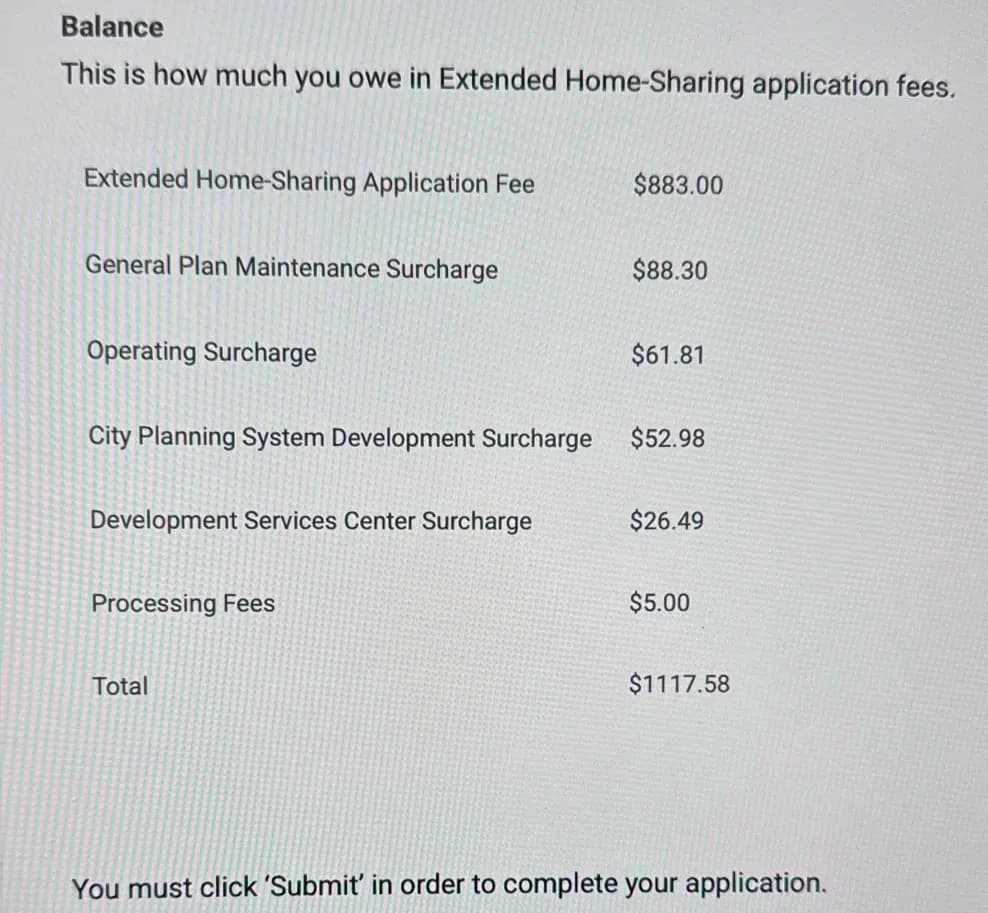
This is a renewal, so it has no neighborhood-notification fee. A first-time Extended application pays that fee as a second charge after the City confirms eligibility, and the City does not publish the amount in the Guidelines or the fee ordinance.
Renewals are annual, and timing matters most for Extended. See how LA permit renewals and the 45-day correction window actually work.
How to Apply for a Home-Sharing Permit in Los Angeles
You apply online through HARP, the City's Home-Sharing Application and Registration Portal, which replaced the old registration system in 2026. HARP also handles renewals, registration changes and the monthly per-night-fee report. Before you start, you will need the following documents:
| Document | Required For | Notes |
|---|---|---|
| California DMV driver license or ID card | All applicants | Must show your true full name and the address you are registering (Guidelines III.1.a.ii). |
| Two proofs of primary residence | All applicants | Two documents from the approved list below, even when your ID address matches (Guidelines III.1.a.iii) |
| Property Owner Authorization to Conduct Home-Sharing | Tenants only | A new City form for every application and renewal. Owner's signature notarized, filed within 30 days of notarization, wet or hand-drawn signatures only. |
| Home-Sharing Records Worksheet | Renewals | The City's worksheet, one per non-Airbnb listing. Airbnb bookings are covered by Airbnb's Platform Agreement, so the City does not ask for those records at renewal (Guidelines III.3.b.iii(1)). |
| Declaration of Zero Bookings | Renewals, if it applies | For a listing on a non-agreement platform that booked zero nights, file the City's declaration with supporting evidence |
| Business Tax Registration Certificate (BTRC) | All hosts, before operating | You can apply without one, but you must get a BTRC with the Transient Occupancy Tax classification from the Office of Finance before you host (Guidelines III.1.e.ii) |
Accepted Proof of Primary Residence
You need two of the following. Each must show your true full name and the address you are registering, as specified in Guidelines III.1.a.iii:
- Current LA County property tax bill showing a homeowners' exemption, with the address as both property and mailing address
- LADWP electricity bill issued within the last six months, showing the address as property, service and mailing address, plus the mailing date, coverage period and due date
- Current California DMV vehicle registration for a personal vehicle
- Current LA County voter registration card, or a stamped voter registration abstract issued within six months
- IRS Account Transcript or Return Transcript issued within six months
- A state or federal benefits notice issued within six months (for example Medi-Cal, Medicare, CalFresh, Social Security or EDD). Two notices can count only if they come from different programs.
- Jury summons from the LA Superior Court or U.S. District Court issued within six months
Leases, pay stubs, and health or vehicle insurance bills are no longer on the list. You can redact personal details the City does not need.
Can You List While Your Application Is Pending?
No. Filing and paying in HARP does not authorize listing or hosting. The old pending registration number is not part of the 2026 Guidelines. City Planning emails you when the application is approved and issues your registration number with a certificate (Guidelines III.2.d). Until then, keep listings offline.
Once your documents are ready, submit your application through HARP. The City's Regular eligibility checklist is the best way to audit your file before you submit.
Live tracker
How Long Does It Take to Get Your Los Angeles Home-Sharing Permit?
Here's the current turnaround we're seeing, pulled from our own Regular Home-Sharing permit submissions to the City of Los Angeles.
Los Angeles Home-Sharing permit turnaround
Regular (part-time) · last approved Oct 2, 2026
Processing times can vary depending on the City's workload, the completeness of your application, and whether any follow-up documentation is requested. Submitting a complete application with all required documents from the start is the best way to avoid delays.
For the full history of our submissions, how we measure turnaround, and what Fast, Normal, and Slow zones mean, see our Los Angeles Home-Sharing permit processing time tracker.
Rules for Registered Hosts in Los Angeles
Once you have an active Home-Sharing registration, these are the rules you must follow (Guidelines sections VI and VII):
| Rule | Detail |
|---|---|
| Registration number on all listings | Must be displayed on every platform. If the number expires or becomes invalid, remove all listings immediately. |
| Report new listing URLs | Add any new listing URL in HARP within 24 hours of publishing it |
| One booking at a time | One guest group under one booking at any time, across all listings and platforms |
| Noise and gatherings | No amplified sound after 10:00 pm, no outdoor gatherings of more than eight people (excluding children) after 8:00 pm, and no paid events or commercial use |
| Safety equipment required | Working fire extinguishers, smoke detectors and carbon monoxide detectors, plus emergency exit information for guests |
| Occupancy limit | Maximum 2 people per habitable room (children excluded from count) |
| Code of Conduct | Must provide the City's official Code of Conduct to all guests |
| Fire zone disclosure | In a Very High Fire Hazard Severity Zone, disclose it in every listing and post no-smoking notices on patios and decks |
| Per-night fee | A City fee on every hosted night, separate from the filing fee and TOT. For non-agreement platforms, report and pay monthly in HARP. |
| Keep records | Keep records of every stay for at least three years |
| 120-day annual cap (Regular only) | Regular registration is limited to 120 days per calendar year |
Los Angeles Transient Occupancy Tax (TOT)
The Transient Occupancy Tax (TOT) is 14% of the total listing price, including cleaning fees, for stays of 30 nights or less. This is a tax charged to the guest, but the host is responsible for collecting and remitting it unless a platform handles it on your behalf.
The City of Los Angeles and Airbnb have a Platform Agreement under which Airbnb collects the TOT and remits it directly to the City on behalf of hosts. You do not need to calculate, collect, or pay the TOT for Airbnb bookings. City Planning currently lists Airbnb as the active Platform Agreement (checked October 8, 2026).
If you accept bookings on other platforms (VRBO, Google Vacation Rentals, Booking.com, or direct bookings), you are responsible for collecting and submitting the TOT to the City of Los Angeles for those nights. Either way, every host needs a Business Tax Registration Certificate from the Office of Finance (Guidelines VII.5). We guide all our owners on TOT compliance so they do not have to work it out alone.
This is not tax advice. Always consult with your tax advisor regarding your specific obligations.
Separate from the TOT, the City charges a per-night fee for every night of Home-Sharing. It is a flat amount per night, not a percentage. The City Council sets it by resolution, and it has been adjusted annually for inflation. Airbnb pays it directly to the City for Airbnb bookings.
For bookings on any other platform, you report and pay the per-night fee yourself through HARP every month. You report the number of nights booked through non-agreement platforms that month, and you still file when the count is zero (Guidelines VII.7). This is new with HARP, and a missed zero-night report is an easy way to fall out of compliance.
The 120-Day Cap: What It Means for Your Rental Income
If you hold a Regular Home-Sharing registration, you are limited to 120 days of short-term rental per calendar year (January 1 to December 31). Once you hit 120 days, you must stop renting until the next calendar year, or upgrade to an Extended registration.
This cap makes tracking your booking nights critical. If you are listed on multiple platforms (Airbnb, VRBO, Booking.com, direct bookings), all nights count toward the 120-day total regardless of which platform the booking came through. Nights booked without a valid registration number count too (Guidelines VI.3).
Our owner portal tracks booking nights in real time across all platforms, so our owners always know exactly where they stand against the cap. For owners who qualify and want to maximize their rental days, we guide them through the Extended Home-Sharing application to remove the 120-day limit.
Enforcement and Penalties
Under the Guidelines, hosting platforms must share listing and booking data with the City (Guidelines VIII). Citations can come from any City enforcement agency. Only sustained citations (after any appeals) count toward suspension or revocation (Guidelines V).
| Violation | Consequence |
|---|---|
| Listing without valid registration | Subject to citation |
| Regular: 2 sustained citations in a registration year | Suspension of 30 days, or as long as a citation stays open |
| Regular: 3 sustained citations in a registration year | Revocation and a one-year Home-Sharing ban |
| Extended: 2 sustained citations in a registration year | Revocation and a two-year Home-Sharing ban |
Citations can be resolved through the City Attorney's Administrative Citation Enforcement (ACE) Program.
How We Guide Our Owners Through LA Permitting
The permitting process requires documents that only you, the homeowner, can provide. But that does not mean you have to figure it out alone. Here is how we support every property we manage:
- Eligibility pre-screening. We check RSO status and primary residence eligibility before onboarding so we only take on properties that qualify.
- Document review before you file. We walk you through exactly what documents you need, help you gather them, review them for completeness, and guide you through the HARP application. Before you submit, we check the address on your ID against the address you are registering, the issue dates and page counts on both proofs, and whether your Records Worksheet totals match the per-night fees you paid. Those are the mismatches we see send files back.
- Registration number compliance. We ensure your registration number is displayed correctly on every listing across every platform.
- 120-day cap tracking. Our owner portal tracks your booking nights in real time, so you can see where you stand against the cap at any time.
- Monthly per-night-fee reporting. We send you a monthly night count for non-Airbnb bookings and walk you through filing it in HARP.
- Renewal windows. We track your expiration date and flag your renewal window early.
- Extended Home-Sharing upgrade. When you qualify, we guide you through the Extended application to remove the 120-day cap and maximize your available rental days.
- Safety equipment compliance. We verify fire extinguishers, smoke detectors, and CO detectors are in place during property setup.
- Code of Conduct distribution. The City's official Code of Conduct is included in our guest communication flow for every booking.
The goal is the most seamless permitting process possible for our owners, so you can focus on the income while we keep you on top of every deadline.
Already registered? See what changed in 2026 and what to do at your next renewal
See which Los Angeles management companies publish real regulatory guidance
Have questions about permitting your property?
We walk every owner we manage through the application, the renewals and the monthly reports. If you are considering short-term rental management in Los Angeles, we are happy to walk you through the requirements.
Frequently Asked Questions About Los Angeles Airbnb Rules
Can I Airbnb my apartment in Los Angeles?
Yes, if the apartment is your sole primary residence, where you live more than six months of the year, and it is not covered by the Rent Stabilization Ordinance (RSO). If you rent the apartment, your landlord must sign the City's Property Owner Authorization to Conduct Home-Sharing. Check RSO status in ZIMAS under the Housing tab before you apply.
Do I need a permit for Airbnb in Los Angeles?
Yes. Any rental of 30 consecutive days or less in the City of Los Angeles needs a Home-Sharing registration from City Planning, and every listing must show a valid registration number. Applications are filed in HARP, the City's Home-Sharing portal.
Can I list my home while my Home-Sharing application is pending?
No. You can list only after City Planning approves the application and issues your registration number (Guidelines III.2.d). Filing and paying in HARP does not authorize listing or hosting.
What ID do I need for an LA Home-Sharing application?
A valid California DMV driver license or California DMV identification card showing your true full name and the address you are registering (Guidelines III.1.a.ii). The City's Regular checklist says the ID address must match the property. A passport or an out-of-state ID does not meet the current requirement.
What happens if I rent without a permit in Los Angeles?
You can receive citations. Under the Guidelines, hosting platforms must share listing and booking data with the City (Guidelines VIII). Two sustained citations in a registration year can suspend a Regular registration for 30 days, or longer while a citation stays open. Three can revoke it, with a one-year ban on Home-Sharing. To resolve a citation, contact the agency that issued it; some are handled through the City Attorney's ACE Program.
Can I get an Airbnb permit if I am a tenant?
Yes, with your landlord's written approval on the City's current Property Owner Authorization to Conduct Home-Sharing form. You need a new form for every application and every renewal. The owner's signature must be notarized, the form must be filed within 30 days of the notarization date, and the City accepts only wet or hand-drawn signatures (no typed or DocuSign signatures).
How long does the LA Home-Sharing permit take?
Based on our most recent Regular Home-Sharing permit submission on September 24th, 2026, we observed an 8-day turnaround time. Processing times vary and can change depending on the City's workload.
Do Beverly Hills and Santa Monica have different Airbnb rules?
Yes. Beverly Hills, Santa Monica, and West Hollywood are independent cities with their own short-term rental regulations, separate from the City of Los Angeles. The rules on this page apply specifically to the City of Los Angeles. If your property is in one of those cities, check with that city's planning department for their specific requirements.
Does Airbnb pay the per-night fee to the City?
Yes. Airbnb has a Platform Agreement with the City, so it collects and remits the per-night fee on Airbnb bookings. For bookings on a platform without an agreement (VRBO, Booking.com, direct bookings), you report the nights and pay the fee yourself in HARP every month, and you still file the report when the count is zero (Guidelines VII.7).
Official City of Los Angeles Resources
Links checked October 8, 2026. The City updates its forms and fees; always confirm the current version in HARP before you file.
| Resource | Link |
|---|---|
| HARP (apply, renew, report per-night fees) | Open HARP |
| Home-Sharing Public Records Portal | Check registration status |
| Administrative Guidelines (revised Sept 28, 2026, PDF) | View guidelines |
| City comparison of 2019 vs 2026 Guidelines (PDF) | View comparison |
| Regular vs Extended comparison chart (PDF) | View chart |
| Regular eligibility checklist (PDF) | Download |
| Regular renewal checklist (PDF) | Download |
| Extended eligibility checklist (PDF) | Download |
| Extended renewal checklist (PDF) | Download |
| Property Owner Authorization to Conduct Home-Sharing (PDF) | Download form |
| Home-Sharing Records Worksheet (PDF) | Download form |
| Code of Conduct (PDF) | Download |
| Home-Sharing Ordinance (PDF) | View ordinance |
| City Planning fee estimator | Estimate fees |
| All Home-Sharing forms and resources | City Planning resources |
| ZIMAS (RSO and fire zone check) | zimas.lacity.org |
Ready to Get Started With Short-Term Rental Management?
We run pricing, guest screening and maintenance, and we walk you through the permit side. Find out what your property could earn with professional management.